
The 2026 CrossFit Games: A Recap, and a Reminder of What This Sport Actually Is
Written by Conquer Athlete Coach Jason Leydon, CSCS
On the 20th anniversary of the Fittest on Earth
Twenty years ago, a small group of athletes gathered in a field in Aromas, California, to do something nobody had a name for yet. This July, in San Jose, that same test returned for its 20th edition — bigger, harder, and more exacting than it has ever been. And once again, it did the one thing it has always done better than any other competition in fitness: it told the truth about who is actually prepared, and who only looked prepared until the standard got hard enough to ask.
The Numbers
The 2026 CrossFit Games ran July 22–26 at the SAP Center in San Jose, California — the 20th edition of a competition that began in 2007 with a handful of athletes in a field and has since become the undisputed proving ground of the sport. Thirty men, thirty women, and twenty of the best teams on Earth qualified through a season-long gauntlet of the Open, Quarterfinals, and Semifinals just to earn a lane on that floor.
To mark the anniversary, the individual competition expanded to 20 events — the most in the Games' history — a deliberate decision to leave no gap in the standard uncovered. Across five days, athletes were tested on nearly every axis fitness can be measured on: a 7,200-meter trail run, a full CrossFit Total of three max-effort lifts, a swim, a 500-meter sprint, a triple snatch under the clock, and an opening workout deliberately built as a callback to the very first Games in 2007 — a reminder that no matter how far this sport evolves, the original standard still counts. The teams division ran its own brutal slate alongside them: a sled push against a decreasing clock, a handstand-walk relay decided by a single second, a GHD-and-wall-ball gauntlet that punished any team with a weak link, and a 5,000-meter team run in which the clock didn't stop until the last athlete crossed the line — a literal, physical demonstration that a team is only as strong as whichever member is struggling most that day.
The Spirit Underneath the Leaderboard
Here is what the scores don't capture. Every one of those 80 athletes and teams on that floor was, at some point in the last twelve months, exactly where you are right now — watching someone else's competition, feeling that pull, and deciding to build toward something. The gap between "inspired by the Games" and "competing in the Games" isn't talent. It's years of unglamorous repetition that nobody filmed.
This is the part of CrossFit that a highlight reel can't transmit: the community underneath the competition. At every level of this sport — from a first-timer walking into an affiliate for the first time, to Semifinals, to the floor in San Jose — the same principle holds. You are surrounded by people whose hardest day is witnessed, whose PRs are cheered by strangers who understand exactly what that lift cost. Nowhere else in fitness is struggle this communal. That is not incidental to CrossFit. It is close to the point of it.
And it's worth saying plainly: the Games are the pinnacle of fitness testing, full stop. Not the most specialized. Not the most impressive in any single discipline — there are better pure runners, better pure lifters, better pure gymnasts in the world. But there is no other competition on Earth that asks a human body to be excellent at all of it, at once, with no advance knowledge of what's coming next. That is what makes it incomparable. A marathoner doesn't have to snatch. A powerlifter doesn't have to swim 1,000 meters. A gymnast doesn't have to survive a 7,200-meter trail run the day before doing any of that. The Games athlete does all of it, in the same week, often in the same afternoon.
This is also, without much argument, the honest answer to why elite athletes from other disciplines so rarely walk onto that floor and compete at the top. It isn't that CrossFit is harder than their sport. It's that their sport, for all its demands, trained one thing exceptionally well — and the Games doesn't ask for one thing. It asks for all of them, under fatigue, without notice. That gap is not an accident. It's a direct testament to what years of CrossFit-specific training actually builds: not a peak in a narrow lane, but a floor that doesn't have a hole in it anywhere.
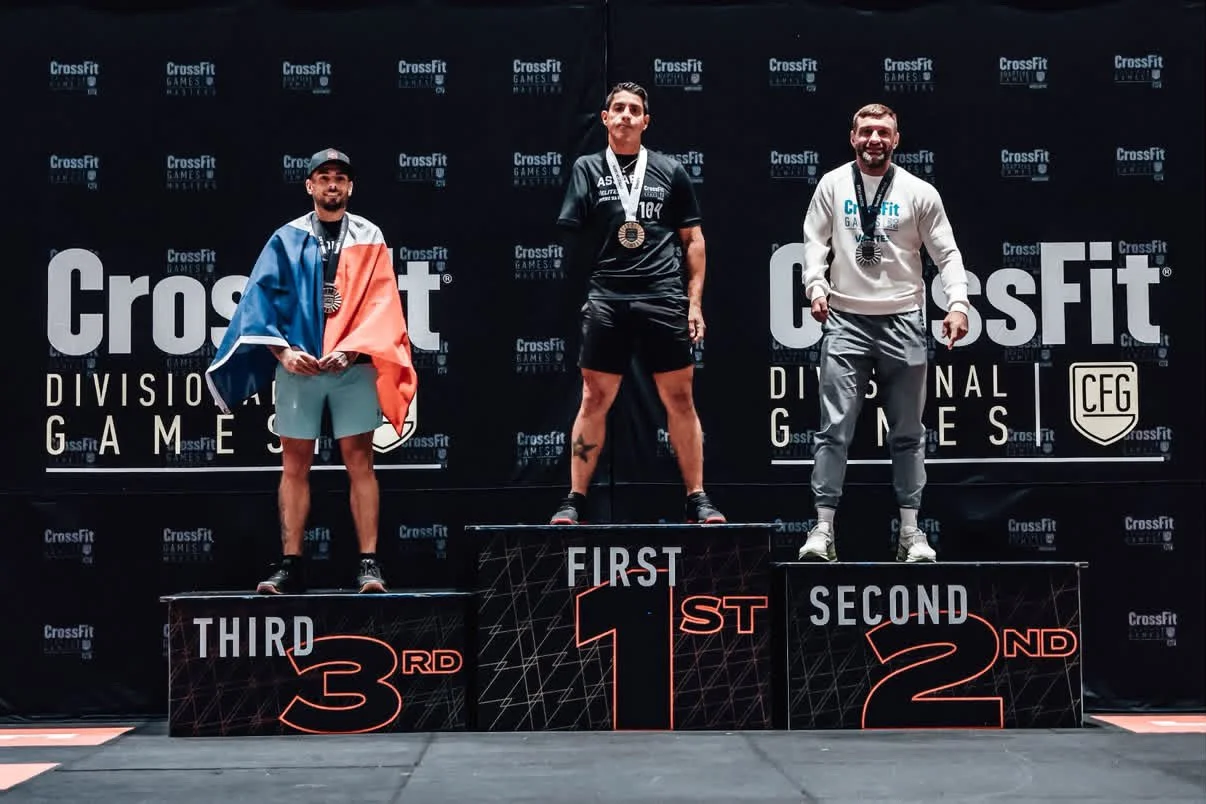
None of the athletes on that podium got there by accident, and none of them got there quickly. Every one of them sacrificed ordinary things — mornings, relationships, money, years — for a standard that offers no guarantee of ever reaching the floor at all. That's worth sitting with. The version of this sport you saw on your screen this week is the visible tip of an enormous amount of invisible, unrewarded work.
What This Means for Your Year
There is a way to watch the Games that leaves you deflated — as a measurement of the distance between you and them. And there is a way to watch it that is actually useful — as evidence of what sustained, honest work compounds into over years, not weeks.
You are not competing against James Sprague or Aimee Cringle. You were never supposed to. The only comparison that means anything is the one between who you were this time last year and who you are right now. That's the whole competition. Not the leaderboard in San Jose — the private one, the one only you're keeping, measured against your own July, your own December, your own last attempt.
So take the fire the Games lit in you, and point it at something specific: not "get in shape," but be measurably better than last year's version of you — stronger, faster, more capable, more consistent. Let this year be the one where you stopped comparing your beginning to someone else's twentieth year, and started building your own.
That's the standard worth chasing. Not theirs. Yours.
Ready to build your own year of progress? Explore our Conquer Athlete Individual Design Coaching Program HERE if you’re ready to level-up your training.
— Jason